


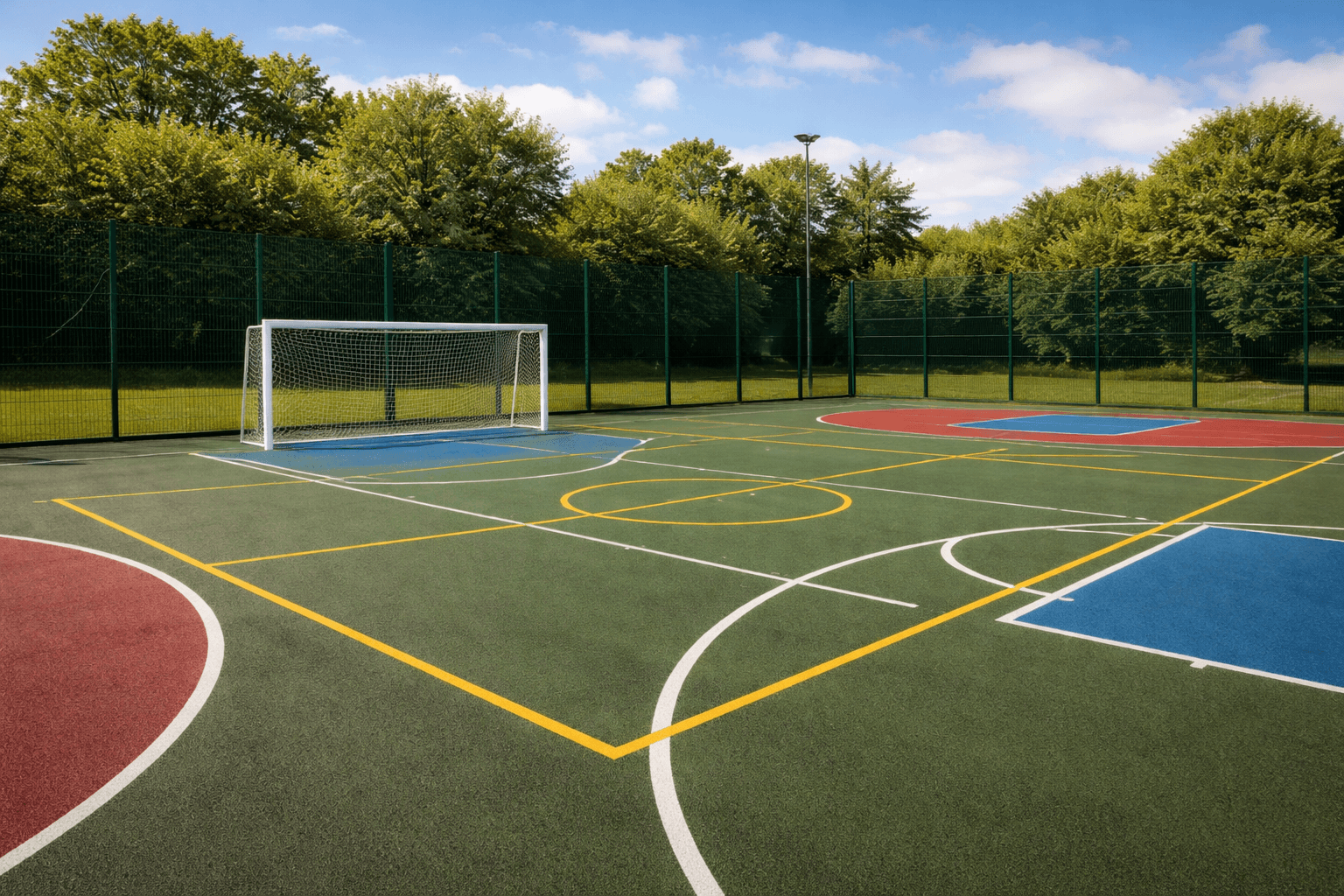
Multi-Use Games Areas have become a defining feature of modern sports provision. From school playgrounds to urban parks and community recreation spaces, these facilities offer something increasingly valuable – the ability to support multiple sports within a single, efficiently designed area.
Basketball, netball, five-a-side football, tennis and informal training can all take place within the same space, often used by different groups throughout the same day. The fencing, line markings and overall layout all contribute to how well these courts function. But one element consistently determines whether a MUGA truly delivers on its potential – the surface beneath it.
What Makes a MUGA Work
A Multi-Use Games Area is a purpose-built outdoor court designed to support a variety of sports within a single footprint. They are particularly valuable in environments where space is limited but demand for physical activity is high – schools where outdoor areas must serve hundreds of pupils, urban parks where multiple community groups need access, and housing developments where recreational space needs to stretch further.
Because MUGAs accommodate different sports, the surface must respond to genuinely different demands. Basketball and netball require reliable traction and consistent ball response. Football places emphasis on grip under sustained foot contact. Tennis needs a surface that supports quick lateral movement without becoming slippery. Getting the balance right across all of these activities is not straightforward, and it starts at the design stage.
Surface Design and Playing Quality
The quality of a sports surface has a direct effect on how games are played. Traction, consistency and ball response all contribute to the experience for users – and to their safety.
A surface with appropriate grip lets players move with confidence, change direction quickly and maintain control during play. When surfaces become slippery, particularly in wet conditions, the risk of injury increases and the quality of play deteriorates. In school environments, this has safeguarding implications; in community settings, it reduces participation.
Consistency matters just as much. Uneven or degraded surfaces affect ball bounce and player movement, making it difficult to maintain a reliable standard of play. This is particularly important in multi-use environments, where different sports depend on predictable surface behaviour.
Polymeric sports surfaces have become the most widely used solution in MUGAs precisely because they deliver this consistency. They provide a stable, durable finish across a range of conditions and activities, maintaining performance characteristics over time rather than degrading rapidly under heavy use.
Durability and Drainage
MUGAs face significant demands. In schools they are used throughout the school day – PE lessons, break times and after-school clubs – and in community settings they are in use by multiple groups on a daily basis. This level of activity places real strain on the surface material.
Surfaces that degrade quickly create problems: cracking, uneven areas, reduced traction and increased maintenance costs. For local authorities and school estates teams managing facilities on constrained budgets, surface longevity is a practical financial consideration as much as a performance one. A surface that lasts fifteen years rather than five represents a fundamentally different return on investment.
Drainage is equally important. Outdoor sports facilities in the UK must perform in year-round weather conditions. When surfaces are not designed to manage water effectively, courts can remain waterlogged or slippery after rainfall – disrupting school timetables, limiting community access and reducing the overall value of the facility.
Porous surface systems allow water to pass through the surface layer and into the underlying structure, reducing pooling and enabling faster drying times. Courts equipped with effective drainage remain usable for more of the year, supporting the kind of consistent, reliable access that makes these facilities genuinely worthwhile.
Choosing the Right Surfacing System
Achieving the right balance between performance, durability and drainage requires specialist knowledge. Surface specification must account for site conditions, expected usage levels and the mix of sports the court will support.
Polymeric sports surfacing for multi-use games areas from providers like Novasport provides a system specifically designed for these demands – delivering consistent play, effective drainage and long-term resilience in outdoor environments. Specialist providers work with schools, councils and designers to assess each project individually and recommend systems suited to the specific requirements of the site.
Organisations such as Sport England emphasise the importance of accessible, well-designed sports facilities in supporting participation and building active communities. Design guidance, including Sport England’s Active Design framework, highlights surface quality as a key element in creating environments that make physical activity a natural part of daily life.
The Bigger Picture
Multi-Use Games Areas are a sound investment in community sport. They make efficient use of limited space and support a wide range of physical activity across different age groups and abilities. But their long-term value depends on the quality of the surface they are built on.
When surface design is treated as a priority – not an afterthought – MUGAs remain safe, usable and effective for years. When it is overlooked, facilities can become liabilities rather than assets. For anyone responsible for delivering or maintaining these courts, it is the one decision worth getting right from the start.
